Strategic Design Workshop at VSM.
Enabling Clarity and Accountable Action.
SUMMARY
Volunteer challenges had created confusion and misalignment across the organisation. Rather than address isolated symptoms, I designed a structured strategic workshop to help participants prioritise what truly mattered. Through neutral facilitation and clear frameworks, ambiguity was converted into focused problems, defined actions, and accountable ownership.
PARTICIPANTS
16 Parent Volunteers
Admin Team
Career Team
FORMAT
4-Hour In-Person Facilitation
Custom Frameworks
Interactive Exercises
PREPARATION
Workshop Primer
Stakeholder Alignment Sessions
Custom Canvas Design
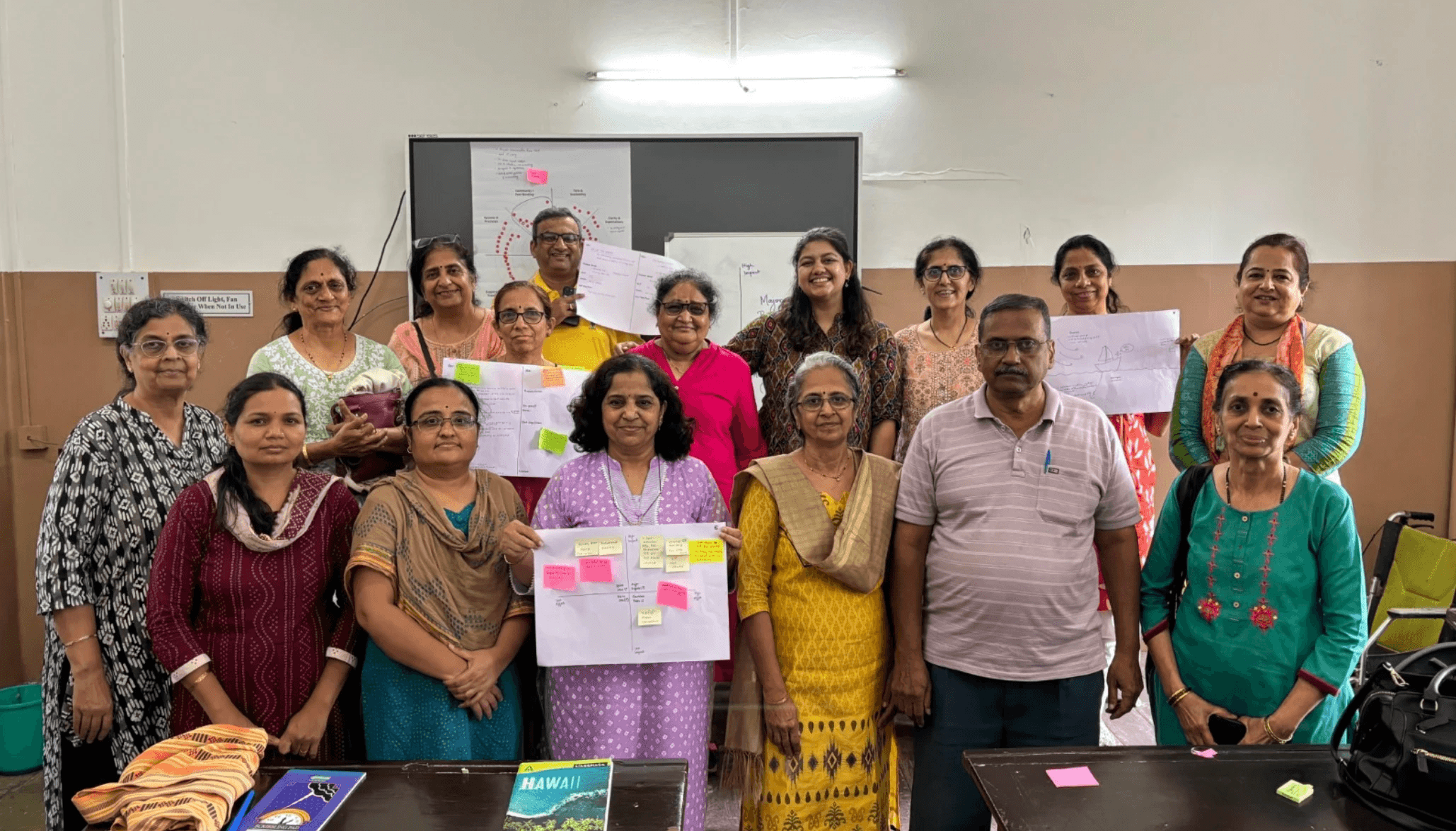
MY ROLE
Designing clarity within complexity, without influencing decisions
Designed and structured the end-to-end workshop experience
Translated ambiguity into a step-by-step decision-making flow
Guided participants from problem identification to actionable plans
Ensured outcomes were documented with owners and timelines
Maintained neutrality - facilitated the process, not the solutions
CONTEXT
At VSM, an education focused non-profit, volunteers faced a lot of challenges daily,
but no one knew where to begin
▶
About the organization
Over 100 internal applications had different
Vidyadaan Sahayak Mandal (VSM), Pune supports economically disadvantaged students through full sponsorship and 1:1 volunteer mentorship.
▶
THE CHALLENGE
Volunteers and administrators were experiencing friction.
Misaligned expectations
Inconsistent engagement
Communication gaps
Questions around accountability
Multiple challenges were intertwined. There was no clear priority, no structured ownership, and no starting point.
The real problem wasn’t a single issue - it was systemic ambiguity.
▶
OUR GOAL
To move from scattered frustrations to structured, prioritized action
Identify and prioritise key volunteer challenges
Move discussions beyond complaints into root causes and ownership
Convert key barriers into actionable solutions
Define ownership, timelines, and next steps
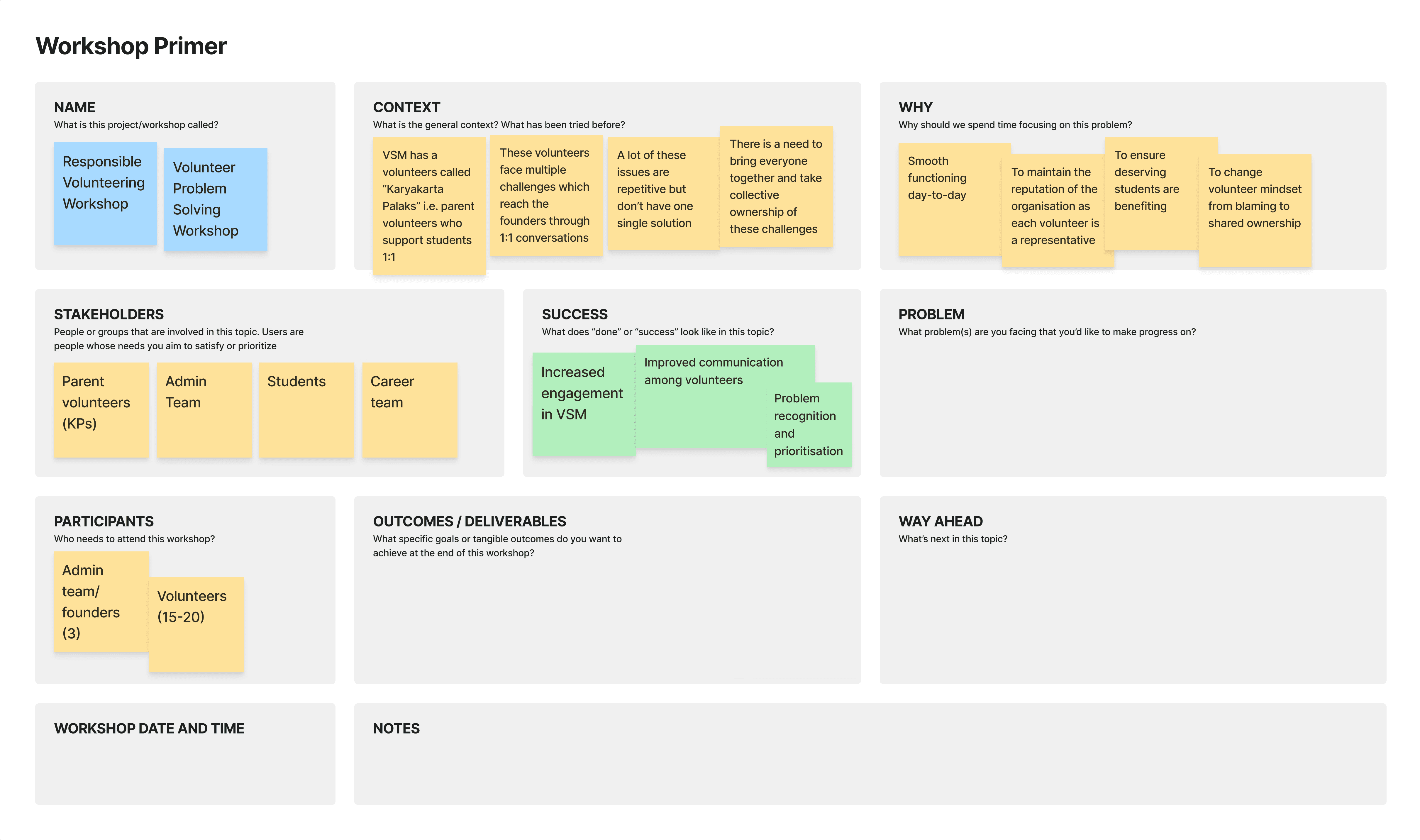
WORKSHOP FLOW
A structured path from exploration to execution.

IMPACT AND FEEDBACK
Clarity translated into confidence, engagement, and momentum.
✅
The group moved from scattered concerns to clearly prioritised challenges within a few hours.
✅
Conversations shifted from frustration to structured, solution-oriented thinking.
✅
Participants left with defined action plans, owners, and next steps - not just ideas.
✅
The workshop introduced a repeatable way to approach complex organisational problems.
4.84 / 5
Average rating
84.2%
Rated the workshop 5/5
No ratings below 4
89.5%
Rated the group exercise
as “Great”
77.8%
Expressed interest in attending
more such sessions
CONSTRAINTS, REFLECTIONS and learnings
Working under real-world limitations
‼️ No Screen at the Venue
The venue screen failed the night before, so I abandoned the PPT and delivered the workshop fully analog using a whiteboard.
📗 Reflection
Strong facilitation should not depend on slides. Clear thinking and articulation matter more than visual support.
‼️ Classroom Setup Instead of Open Space
Budget constraints limited us to a standard classroom instead of a flexible collaborative space.
📗 Reflection
Spatial design directly influences energy and participation, and must be factored into workshop planning.
‼️ Limited Time (4 Hours)
We attempted to move from systemic ambiguity to action planning within a compressed 4 hour window.
📗 Reflection
Complex organisational challenges require phased sessions to allow depth and sustainable alignment.
‼️ No Structured Follow-Up
A follow-up session to track execution and impact was not scheduled after the workshop.
📗 Reflection
Accountability loops are essential to translate workshop momentum into lasting change.
LEARNINGS
Facilitation is less about answers and more about designing the right conversations
Ambiguity often signals prioritisation gaps, not capability gaps
Neutral facilitation builds psychological safety and trust
Structured tools reduce emotional friction in group settings and help participants take ownership of challenges
Time and space significantly influence participation quality
Sustainable change requires follow-up and iteration